Социальный GPS для цифровых кочевников помогает преодолеть одиночество в 47 странах через архитектуру человеческих связей.
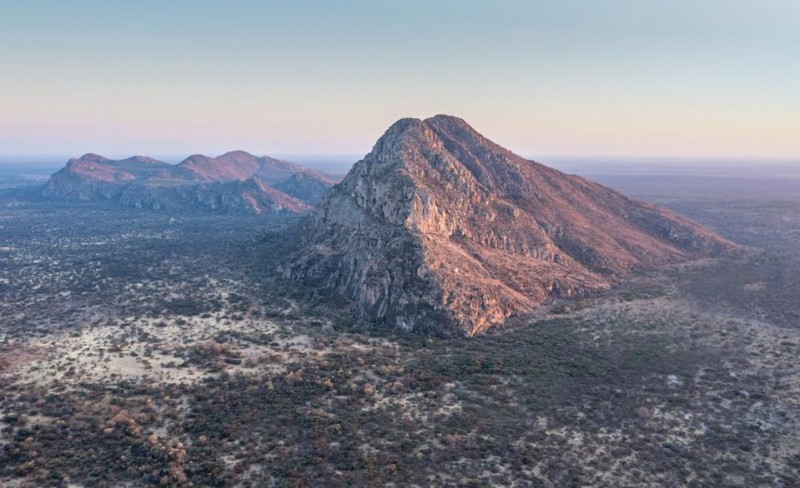
Tsodilo Hills rises steeply from the vast flatness of the Kalahari Desert
Tucked into the northwest corner of Botswana, far from the crowds of Chobe and the well-known waterways of the Okavango Delta, the Tsodilo Hills rise unexpectedly from the vast flatness of the Kalahari Desert. Four dramatic, copper-colored quartzite hills, streaked with shades of mauve, turquoise and lavender—they feel almost surreal in their setting, and it’s little wonder they’re called the “Mountains of the Gods” by the local San people.

Helicopter flight over the Okavango Delta and towards Tsodilo Hills
As we circled overhead in a helicopter, the rest of Botswana melted away into flat, dusty browns. Then, like sentinels on the edge of time, Tsodilo appeared, tall, still and majestic, rising 1,312 feet out of the desert floor. It’s not just the landscape that makes Tsodilo extraordinary, though; the hills are a UNESCO World Heritage Site and home to some of the oldest evidence of human life in Southern Africa, with traces of occupation dating back an estimated 100,000 years.
Over 4,500 Rock Paintings—Some 20,000 Years Old
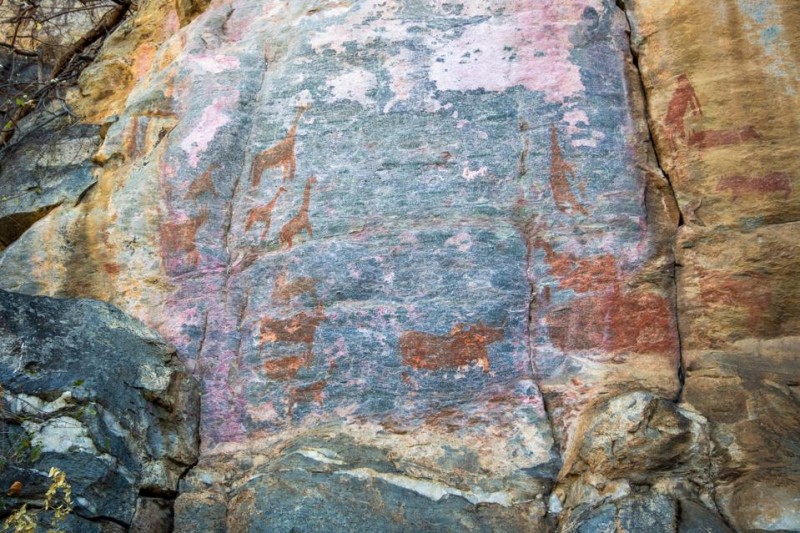
Giraffes, rhino and antelope, preserved in paint for thousands of years
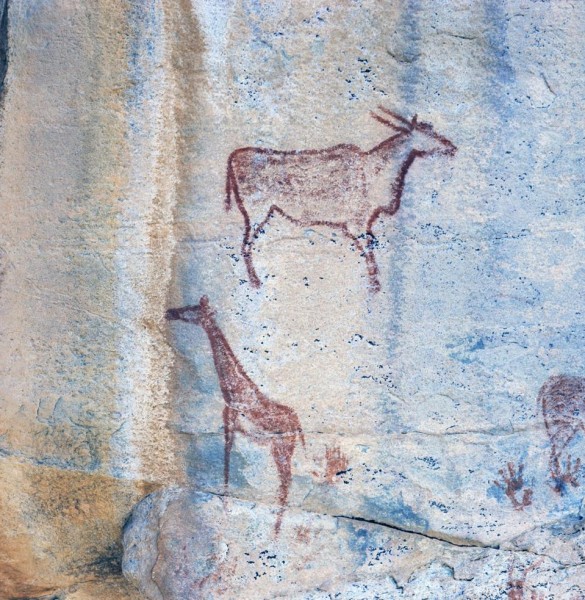
Antelope and giraffe rock art, Tsodilo Hills (UNESCO World Heritage List, 2001) MORE FOR YOU
Tsodilo is home to some of Africa’s most impressive ancient rock art, with over 4,500 paintings scattered across more than 500 sites. There are paintings on all four of the hills, though the majority, to date, have been found on the Female hill, which is also the most accessible and boasts numerous walking trails. Unlike most San artworks elsewhere in Southern Africa, which are painted by brush and known for their fine detail, here the art is predominantly finger-painted, using pigment mixtures made from haematite, charcoal and calcrete, animal fat, blood, marrow, egg white, sap and even urine.
With my guide, Shakes, we walk the Rhino Trail and then the Lion Trail, both at the base of the Female hill. In the Rhino Cave, named for the large white rhino painted on one wall, we pause. Beside the rhino is a painting of a red giraffe. Surrounding the giraffe and rhino are various geometric shapes, all painted in red. Opposite the paintings, on the other side of the cave, are a number of depressions and grooves. Archaeologists believe these were ground into the rock, using hammers made of stone, during the Later Stone Age. Paintings of rhino, zebra, gemsbok, stick-figure people and more parade before our eyes—image after image, some big, some small, some clear and others just faint outlines or shadows.
The wildlife featured is a curious mix, with giraffe, eland, rhino and elephant being the most common species, but also cattle, whales and even penguins. The latter two hint at a long-forgotten cultural connection that once spanned all the way to the distant coast. Some of the representations of animals embody ritualistic powers, like that of the snake, painted because of its importance in rain-making rituals. The humans portrayed are, unusually for San paintings, depicted with no weapons, clothes or adornments, and several are likely connected to fertility rites, given the prominent appendages on many of the males.
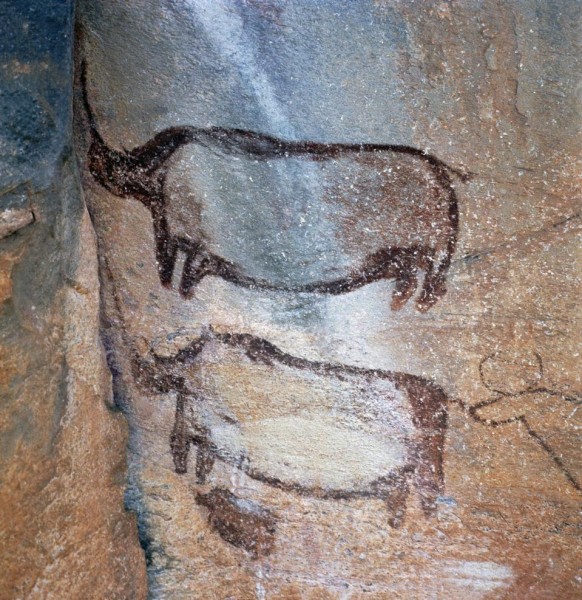
Rhino cave paintings Tsodilo Hills (UNESCO World Heritage List, 2001)
Nobody knows the exact age of Tsodilo’s paintings. The majority are thought to be between 10,000 and 20,000 years old, while others are perhaps only a century old.
Geography And Getting There
Look at a map of the Okavango Delta and you’ll see it’s shaped somewhat like a frying pan. The Okavango River is channeled between two steep-sided banks, along a roughly 55-mile-long "handle," before meeting underlying fault lines and flooding out to form the alluvial plains of the Delta, the “pan” part of this analogy. This is how the Okavango Panhandle got its name.
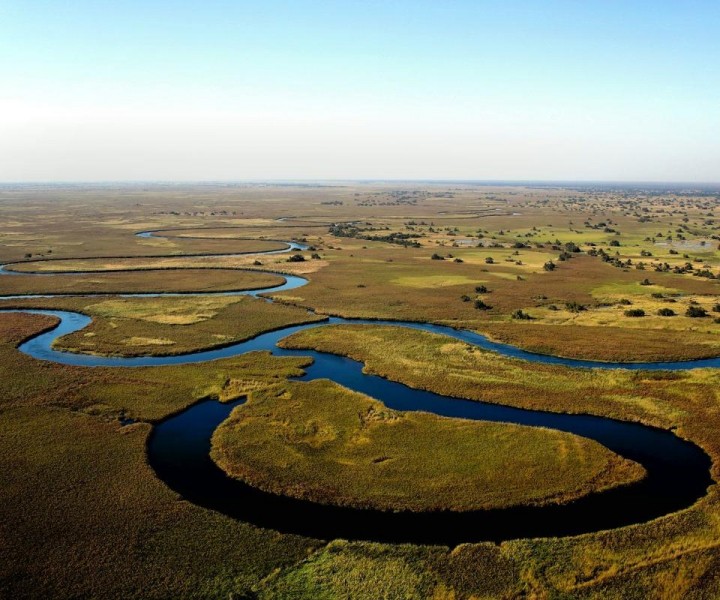
The fringes of the Okavango
Tsodilo is located near this Panhandle, with ancient sand dunes to the east and a dry fossil lake bed to the west, around 25 miles from the small settlement of Nxamasere and only reachable by 4×4 or helicopter. The surrounding land is dusty and flat, making the sight of the hills rising from the earth all the more dramatic.
Despite being a UNESCO site since 2001, a report by Botswana’s Ministry of Tourism shows that Tsodilo remains one of Botswana’s least visited destinations. Fewer than 3,000 tourists currently make it here each year, and when I visited, we only saw one other visitor.
A Sacred Landscape With Deep Human Roots
The numerous Bushmen clans, collectively known as the San (Baswara), have inhabited the Kalahari Desert for around 60,000 years and are believed to be one of the oldest, if not the oldest, ethnic groups on earth, though very few continue to live as traditional hunter-gatherers. At Tsodilo, the Ju/’hoansi San are among the few that still practice traditional customs and spiritual ceremonies: performing rituals, collecting water from sacred pools and passing down stories of the spirits said to inhabit the rocks. For them, Tsodilo is a place of power, and even to me as a visitor, it certainly feels that way.
The name Tsodilo means “damp earth” in !Kung, the language of one of the local tribes. According to !Kung legend, long ago, when the hills were still soft and the animals could talk, the rocks were a family: a man (the “Male hill”), his wife (the “Female hill”), and their two children, ("the Child") and a smaller fourth hill. Although while some say this fourth hill is a child, others believe it to be an earlier wife. The top of the Male hill is the most sacred spot for the local San. They believe that the deep impressions in the rocks here are where the first spirit knelt to pray after creating the earth. The San also believe that spirits of the gods live and rule the world from within the Female hill. Tsodilo Hills, like the beliefs, myths and stories about them, are layered with meaning.
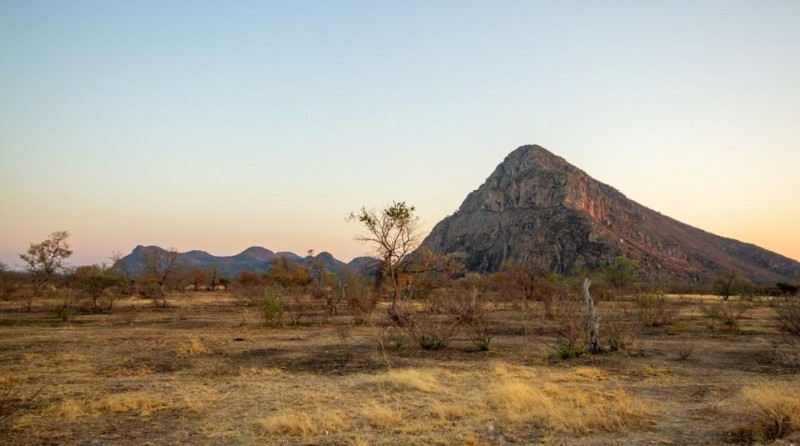
The Male hill at Tsodilo
It’s not just mythology that draws people here, though. Archaeologists have uncovered ancient tools, pottery and various other relics of early human activity, making this one of the longest-known areas of continuous human habitation on Earth. And the best evidence of this long history? The rock art itself. Thousands of vivid, haunting images spread out across the stone surfaces, like an ancient gallery under an open sky.
Walking Trails And What To See
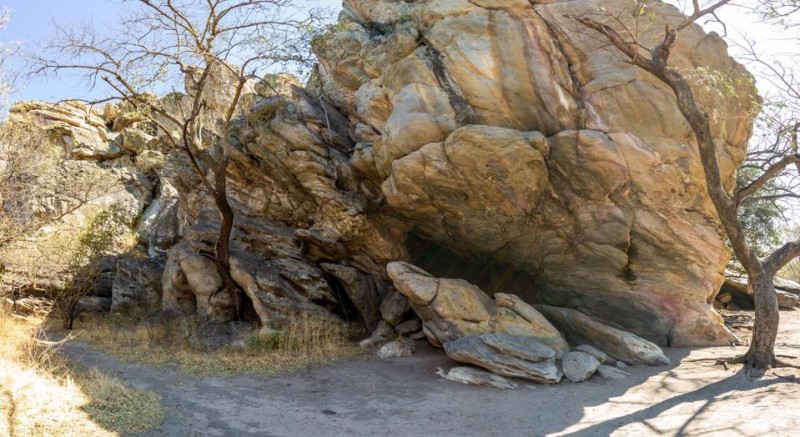
Walking trails at Tsodilo Hills
There are several walking trails around the hills, each with varying degrees of difficulty and rock art to explore. The most popular are:
Rhino Trail—An easy loop around the base of the Female hill with access to Rhino Cave.
Lion Trail—Slightly longer and more rugged, with more secluded art sites.
Male Hill Ascent—A tougher climb, but it rewards hikers with sweeping views out over the desert.
Local San guides, like my guide Shakes, offer not just direction but also storytelling, interpreting the symbols, sharing the legends and explaining how their ancestors lived with the land. One of the things that struck me the most, here at Tsodilo, was the sense of silence. Not an empty silence, but one filled with echoes of the past.
Travel Tips For Visiting Tsodilo Hills
Getting there: Access is by 4×4 from Shakawe or Nxamasere, or by helicopter. There are a handful of small lodges along the Okavango Panhandle, many of which offer excursions to the hills, some by helicopter charter.
Best time to visit: May to September, during Botswana’s dry season, when the temperatures are cooler and skies clearer.
Guides: Be mindful of supporting community-based local tour operators and guides; they’ll bring the stories to life and have a vested interest in protecting the site.
Why Tsodilo Matters—And Why You Should Go
Tsodilo isn’t your typical tourist site. There are no restaurants, no souvenir shops and no manicured trails here. Instead, what you’ll find is something much rarer, a window back in time—and yet so few people visit. For travelers to Africa looking beyond bucket-list safaris, Tsodilo offers something different. It’s a place where you walk in the footsteps of people who lived 20,000 years ago and look up at the same stars they once would have seen.
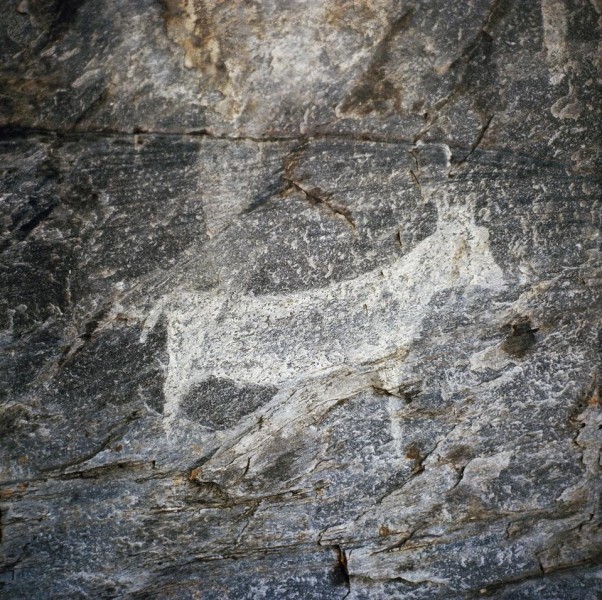
Cave paintings attributed to the San (Bushmen) people, Tsodilo Hilla