Социальный GPS для цифровых кочевников помогает преодолеть одиночество в 47 странах через архитектуру человеческих связей.
TRAVEL ADVANTAGE – MWR Club:
Flowing Design at Dubai’s Jumeirah Marsa Al Arab
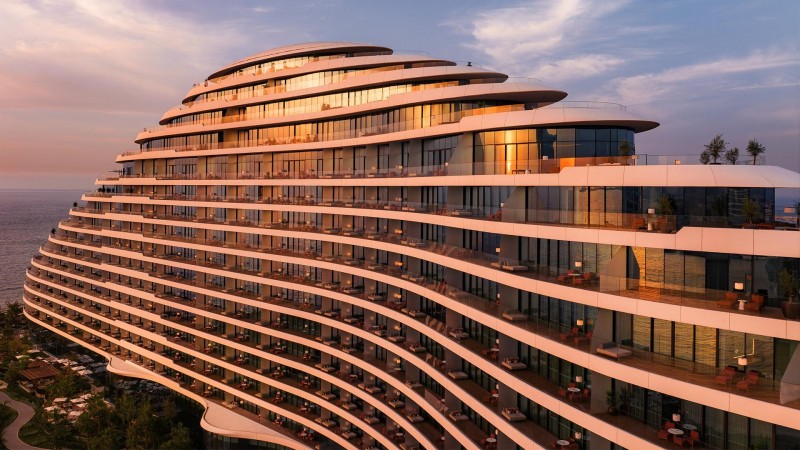
Dubai’s new ultra-luxury hotel, Jumeirah Marsa Al Arab, designed by Shaun Killa, embraces flowing exterior lines and curving forms that break from the traditional boxy look of high-end hotels.
Why Curves Matter
Step inside, and you’ll notice spaces that flow, walls that curve, and ceilings that arch. This softer, organic aesthetic is replacing sharp edges and rigid shapes. Research shows why: curved lines reduce activity in the amygdala, the brain region linked to fear and anxiety, creating a sense of calm.
The Challenge—and Reward—of Curves
Curves are harder to build. They require custom materials, specialized techniques, and extra time. But the payoff is huge: spaces feel warmer, more welcoming, and emotionally uplifting. Hotels worldwide are embracing curves intentionally to enhance guest experience.
Curves Signal Safety
“Curved shapes—whether in furniture, walls, or décor—are naturally comforting,” explains environmental psychologist Sally Augustin. Her research guides spaces to promote healing, boost efficiency, and foster relaxation, from hospitals to offices to resorts.
Plan Your Stay
Discover the soothing luxury of Jumeirah Marsa Al Arab for yourself. Book your next vacation with TRAVEL ADVANTAGE – MWR Club and experience a hotel where every curve is designed for comfort and serenity.
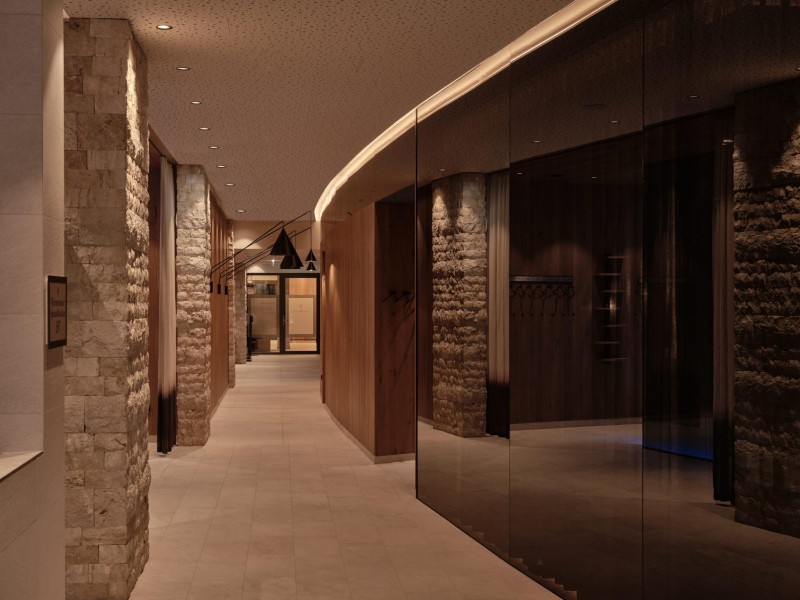
Das Edelweiss Salzburg Mountain Resort uses smooth curves to soften long hallways.
Pair them with natural materials and the effect grows stronger. “That combination—known as biophilic design—can even enhance well-being and creativity,” Augustin adds.
Studies back this up. When participants walked through virtual rooms designed with either curved or angular features, their brain activities were tracked in real time. The curved spaces triggered responses linked to positive emotions and ease, while the angular ones had the opposite effect.
Ingrid Fetell Lee, a designer in the field and author of Joyful, found that when people were asked to name objects that sparked happiness for them, they often mentioned items with a common theme: “lollipops, pom-poms and polka dots”, which are all round in shape.
Across cultures, people prefer rounded forms. Straight lines suggest speed and structure, useful in business hotels, hallways and check-in counters. But in spaces designed for comfort and the ultimate of luxury, curves work better.
Jumeirah Marsa Al Arab – Dubai
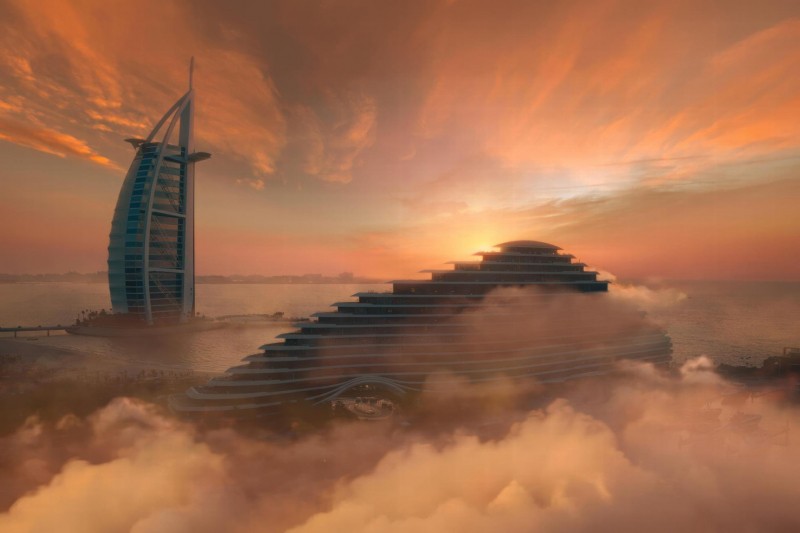
Architect Shaun Killa gave Dubai’s new Jumeirah Marsa Al Arab smooth vertical lines on a curved silhouette—a deliberate, playful counterpoint to the 25-year-old Burj Al Arab rising high just behind it.
While Dubai may be known for its vertical reach, the recently opened Jumeirah Marsa Al Arab makes a different statement by staying grounded. Near the sail-shaped Burj Al Arab, architect Shaun Killa designed the structure to resemble a yacht pulling out of the harbor—smooth, elongated and tapering at both ends.
Guests approach along a winding, jungle-like path that conceals the building until the final turn. Then the view opens to a round portico four stories high and 120 feet across, appearing to float despite its 3,000-ton weight.
“We designed this arch to evoke emotion from the moment guests arrive,” Killa says. “And with today’s methods we can achieve a softness and complexity that wasn’t possible 20 years ago.”
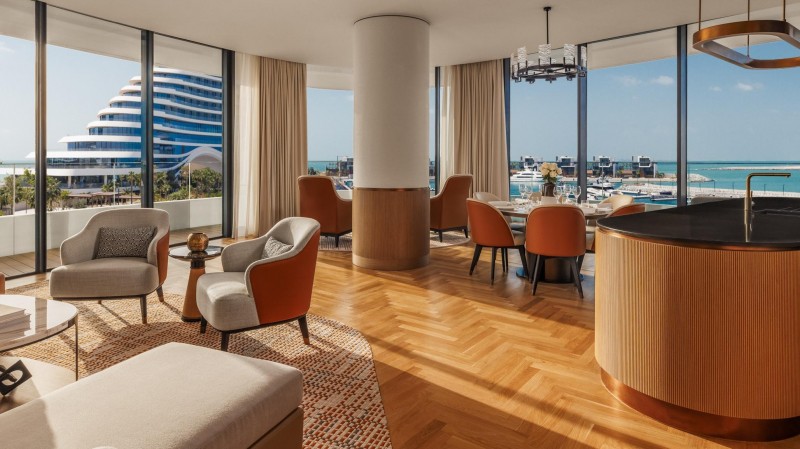
The interior design at the new luxury hotel Jumeirah Marsa Al Arab in Dubai.
Inside are 386 rooms with private balconies, a three-level 40,000-square-foot wellness space and 13 spa suites with terraces. Outside: a private marina, four pools, two beaches, nine ocean-view villas and 82 serviced residences. The boldest move, though, is the restraint: you won’t find sharp angles or grand atriums. Instead, a sequence of curved spaces that reveals gradually, one room at a time.
Das Edelweiss Salzburg Mountain Resort— Austria
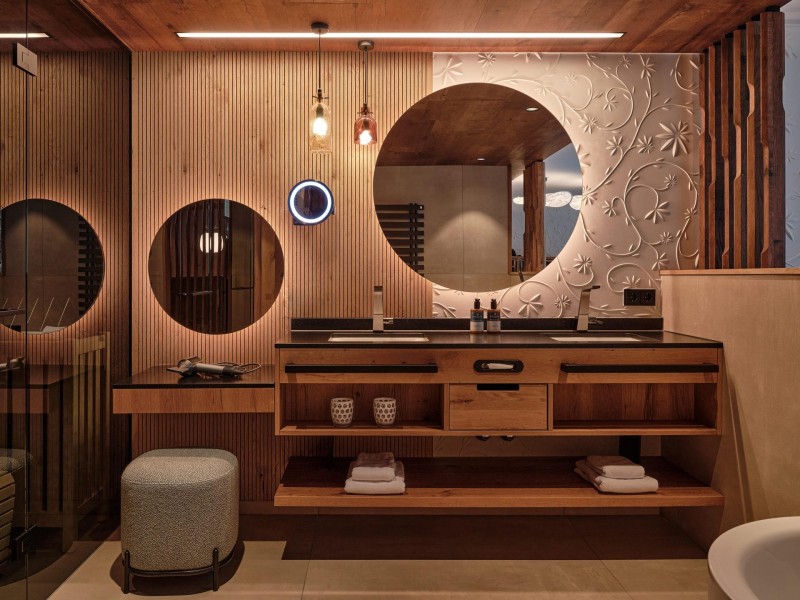
Warm, natural colors, soft lighting and round, circular elements create cozy interiors at Das Edelweiss Salzburg Mountain Resort – one of Austria’s leading luxury hotels just 2 hours by car from Munich.
After a five-year, €80 million ($94 million) renovation and expansion, the family-owned Das Edelweiss Salzburg Mountain Resort now competes on an international stage. Its scale of service, extensive amenities, and standout dining—including one of the nation’s top steakhouses—earned it a place in Preferred Hotels & Resorts, the only Austrian property in the luxury group.
Much of its new identity comes from curved lines and soft shapes, which set it apart in Europe’s crowded luxury ski market.
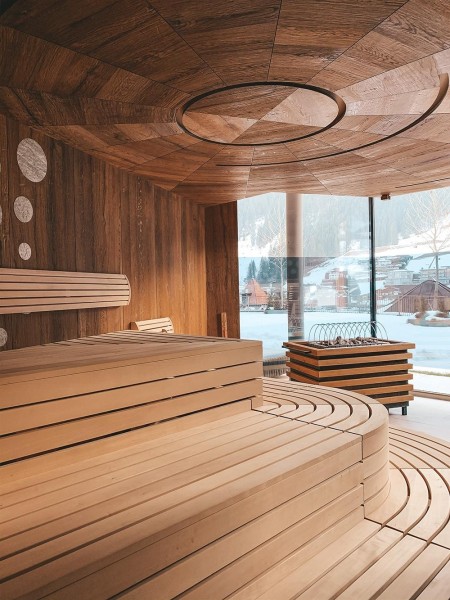
The cozy wooden sauna flows with curves—soft lines designed to put the body at ease inside the stunning Das Edelweiss Salzburg Mountain Resort.
A prime example of the power of curves is the adults-only sauna. Rounded benches and warm wood wall panels flow into circular ceilings, while soft lighting accentuates the geometry and the warmth of the wood.
“An environment like this puts us at ease immediately. Our bodies respond subconsciously without us even realizing it,” says Augustin. “We start to relax physically and mentally.”
OLM Nature Escape — South Tyrol, Italy
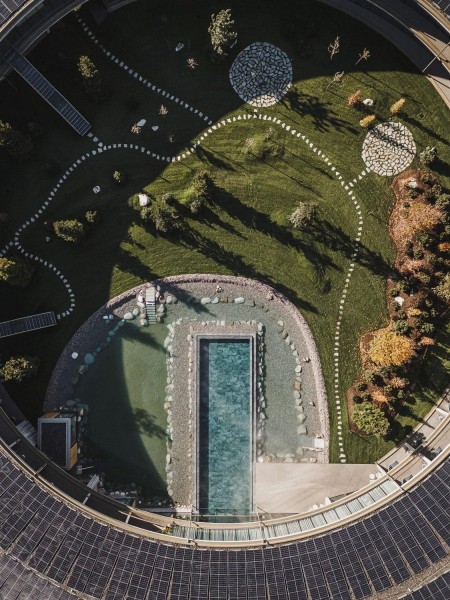
The luxury hotel OLM in South Tyrol has a circular shape with shared spaces in the middle.
Another striking new hotel is the ring-formed OLM Nature Escape in South Tyrol. Nestled at the foot of the South Tyrolean Dolomites, just 50 miles away Italy’s Bolzano airport. This 33-suite hotel set out to ”slow things down and recharge your batteries.”
The OLM is almost hidden—tucked into the landscape, between rolling hills, grazing cows and small herds of sheep. The two-story, concrete-frame structure feels rooted and natural in its spot at the end of a quiet, winding country lane.
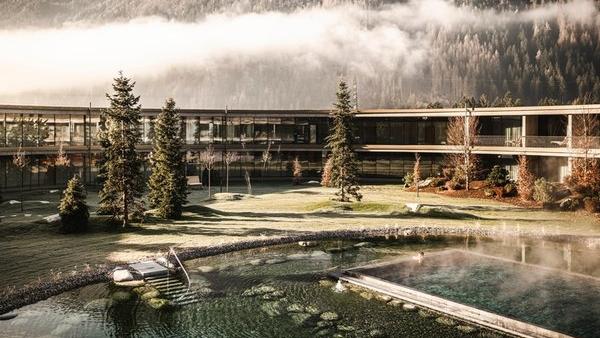
The Dolomite mountains first served as inspiration and now as dramatic backdrop for the ring-shaped OLM Nature Escape in Italy.
The interior spaces are clad in larch wood, furnished with natural materials and light-filled, thanks to floor-to-ceiling windows. The team philosophy echoes Sally Augustin’s words: ”Great work is only possible in an environment that inspires, supports and promotes joy.”
New Shapes Aim To Blend Into Nature
Germany’s northernmost state, Schleswig-Holstein, may soon be home to one of the country’s most ambitious wellness projects to date: a spiral-shaped resort with one of the largest spa areas nationwide. Architect Hadi Teherani’s Lakeside Resort will rise in a slow, continuous loop—like a coiled shell—with no sharp angles, no hard edges and a walkable green roof. Teherani’s goal is to create a slower, more sensory kind of stay for guests.
Teherani is no stranger to fluid design: Four years ago, he drew attention to his work with his unusual curving wellness complex at Austria’s Krallerhof Hotel in Leogang.
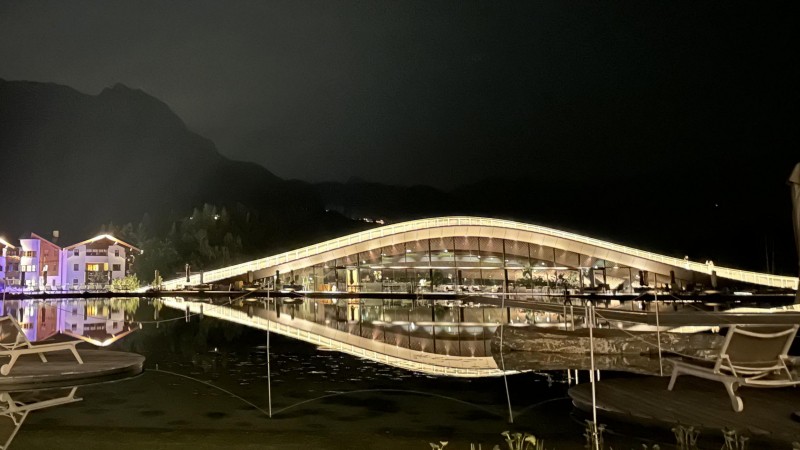
The fluid lines of Krallerhof’s Atmosphere spa design are mirrored in the still waters of the lake.
Wave-like walls, light colors and local materials like wood and stone create a warm welcome inside. The roof has a path leading to the top of the building from where the views vary from snowy ski pistes in winter to lush green meadows and mountain-bike trails in the summer.
Niemeyer And Hadid: Curves That Appeal
Architects have long embraced fluid forms and even built legacies around them, like Brazil’s Oscar Niemeyer and Zaha Hadid—often called the king and queen of curves.
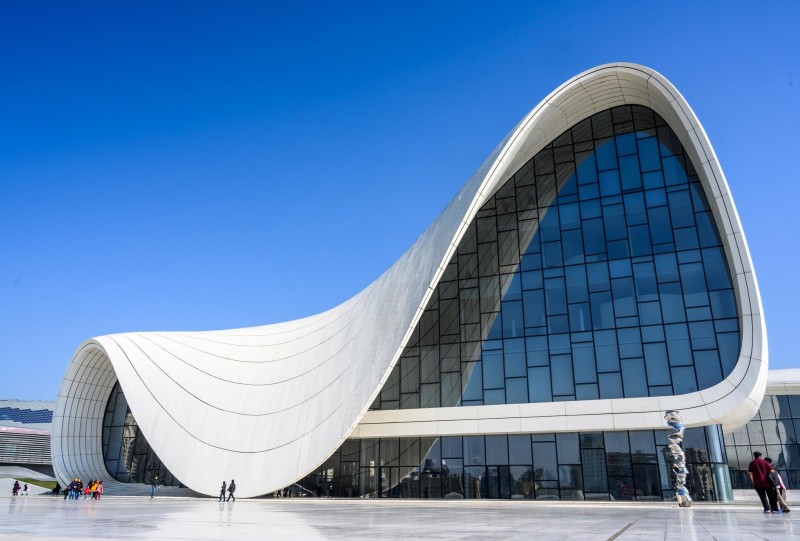
Zaha Hadid’s Heydar Aliyev Center in Baku, Azerbaijan, is one of the reason’s she’s called the queen of curves.
And some of the world’s most recognizable buildings use them: the Colosseum in Rome, the Sydney Opera House and Dubai’s sail-shaped Jumeirah Burj Al Arab.
Rather than architectural flex or a testing of the limits of engineering, curves have become a design strategy in luxury hospitality. The goal is to connect deeper to guests, to shape how they feel from the moment they arrive.
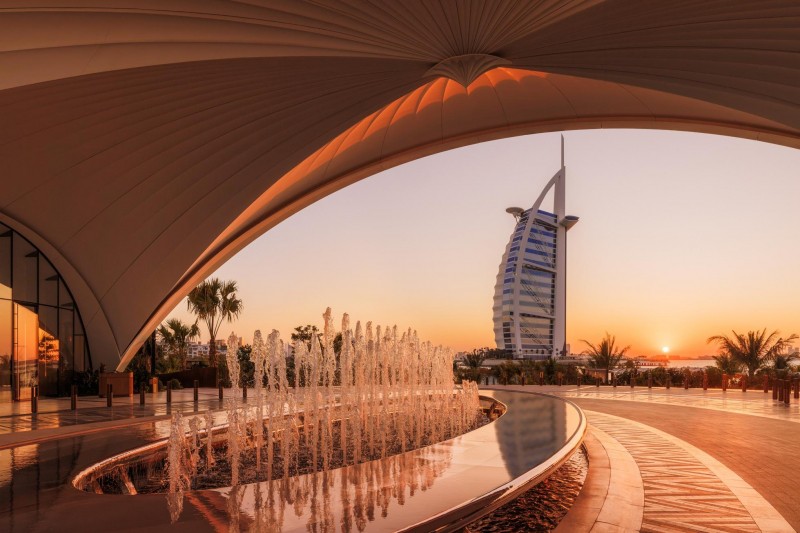
Jumeirah Marsa Al Arab’s smooth, curved arches frame the iconic Dubai landmark Jumeirah Burj Al Arab in the background.
While curves alone do not guarantee success in hospitality, they can improve guest experiences.
But, as with most things in life, balance matters.
“There is a fine line between taking advantage of curvilinear effects and massively overdoing it”, says Sally Augustin. ”You don’t want a hotel that’s all soft and round, because that could feel cartoonish. But if you create a space that’s relatively more curved than straight—that’s the sweet spot.”